
The small field barn
Text and photo: Trygve Martinussen. First published in the magazine Kulturarven , no. 100, June 2026.
A mini-project close to philosophical cultural history
How small does a building have to be before you can say it's not worth preserving? The 4 m2 "wreck" had no use value and was very close to falling down in 2013. A firematch is the solution, most people thought.
The tree has stood for years as a guide to the plot where the world-renowned Austrian philosopher Ludwig Wittgenstein built himself a house in 1914. He retired to Skjolden this year to find peace of mind here for philosophical work. He established himself as one of the most important philosophers of the 20th century, see wittgenstein .
The access road to the now protected area with the resurrected Wittgenstein house - also protected - passes close by this small barn. The barn is in itself a cultural monument, a memorial to how little a house was needed to save vital crops for sheep and goats from defoliation.
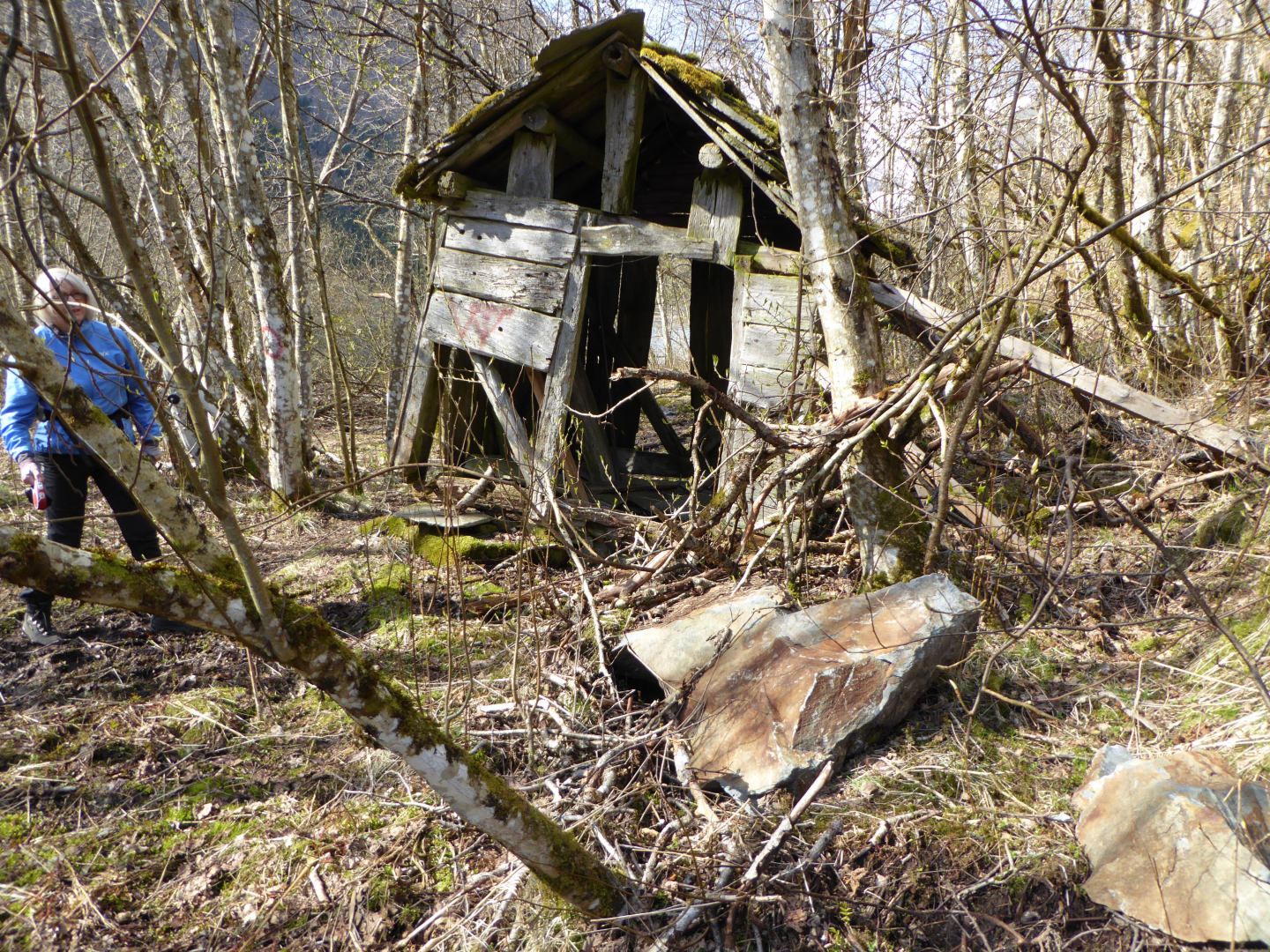
The small field barn - supported for salvage in 2013
Background and goals
The sign was on the Wittgenstein site for the first time in 2013. Løa was on the verge of collapse and begged for help. The first aid was to get three support posts in place. Soleis also managed through the snowy winter of 2014/15, but now there is a great urgency for action.
The first challenge was to find the owner, Oddvar Johan. Bolstad With so many houses to take care of, this unassuming outbuilding is not high on the priority list. Finances and time are notoriously scarce resources in agriculture, and not all buildings can be taken care of.
The landowner was very positive about the initiative. The goal was to carry out "lifesaving" by means of a short skipper's take. Together with me, I had at my disposal my good friend Jon Tuveng (a newly retired gynecologist and log house enthusiast) ready to take on the task for three days. Furthermore, I had contracted 1.5 days of professional assistance. Restoration as original and with as many recycled materials as possible was the philosophy.
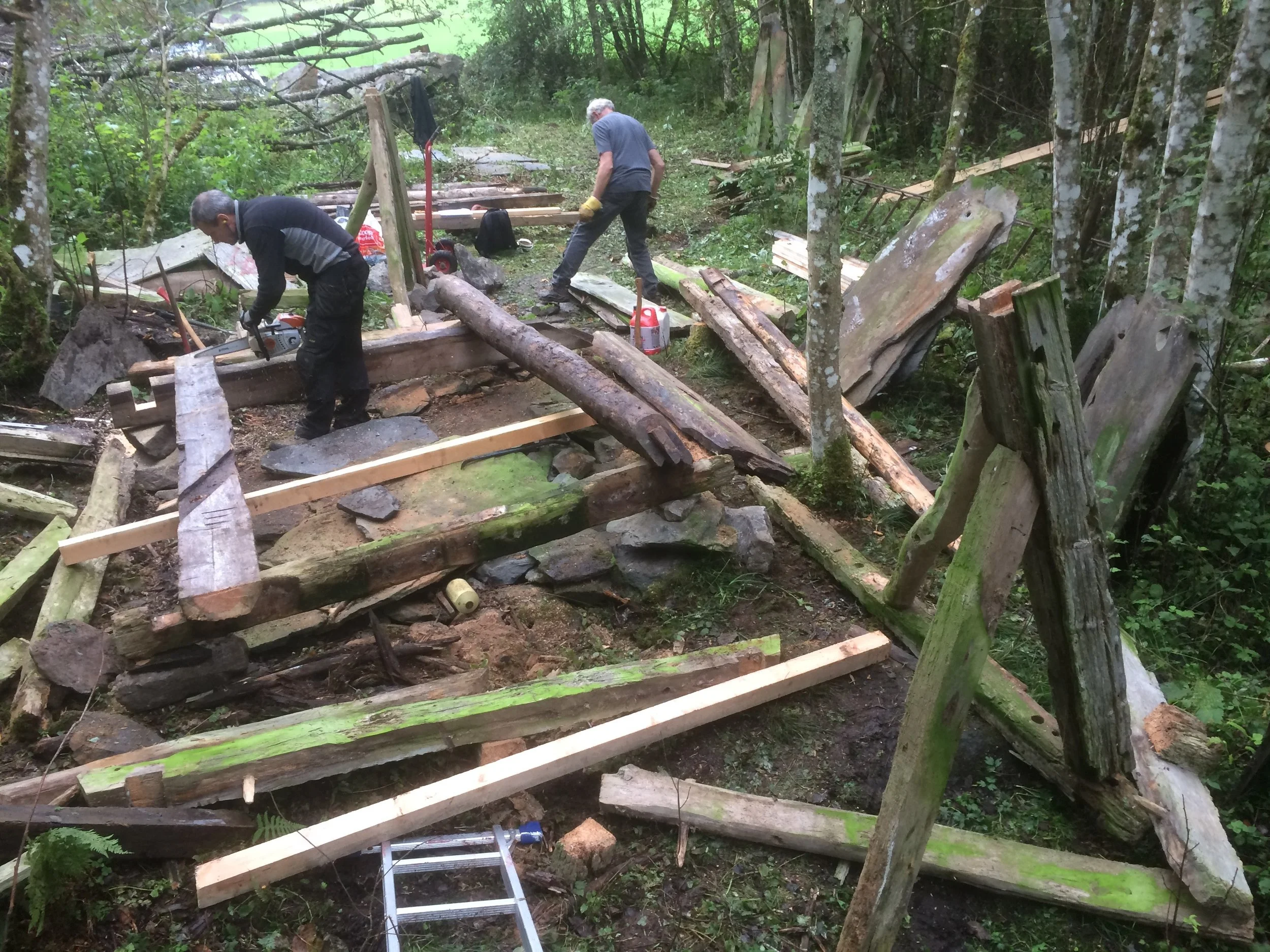
Back to square one, total disassembly was necessary.
The implementation
The first measure was, together with the owner who also had a collapsed barn in Mørkridsdalen, to extract usable recyclable materials with a tractor from the ruins of this barn. Supplementation of roof tiles for the roofing was also included in the trailer.
The first step after clearing the area of windfall etc. was to take down the slabs from the roof. A man on the life-threatening roof with rotten shingles climbed up to attach straps to the slabs, one who controlled the lowering of the slabs on the opposite side and a third man received the slabs down on the ground.
The goal of the work on the first day was to dismantle the panel but with scaffolding remaining for inspection of the structure for the professional the next day before the reconstruction.
In the evening of the first day, the volunteers also managed to go with their trailers to Sønnesyn Sag, where we had full trust from the owner Einar to pick the right supplementary materials ourselves.
Tuesday morning, the much-needed professional help arrived, Håkon Skrindo, a civil engineer. Håkon is more interested in working with lathing than with computers. He runs his own business in Gol, delivering lath buildings.
The shed was built with heavy panel boards on scaffolding. But the upper part of one of the gable walls was made of logs, probably stumps of recycled materials from another house. Despite the advanced surface rot in the sapwood, we wanted to put the small log triangle back as it was. Experience from other restoration projects Luster has shown a solid amount of eel (ore) in ancient log logs.
With intense effort, all reconstruction was completed by six o'clock on the second day.
Wednesday morning revealed itself with pouring rain. The crew was then reinforced with Magne Feigum from Luster, the man who does not know the word no when it comes to taking on a volunteer roof. The job would have been very difficult without this help from a strong fourth man. Even though the eaves were not high, the largest slabs were difficult to get up and into the right place on the roof for two men down.
Wet and tired, we returned with heavy burdens and questions, just like the philosopher Wittgenstein did 101 years earlier with his thoughts.
Why do we do this? Why restore with old materials, and not see new, white, nice things; that's what "most people" want to see? Why the lying panel in the front? Why ask questions? Why try to answer? Why can the answer never be right?Wittgenstein collected 717 reflections/questions in his Zettel box, and answered about half of them himself.
Half of his answers were the opposite of what he thought was right.
We leave the questions to the readers, but we can include a comfort from W: "It takes an enormously long time before anything is clear to me." (1.5.1930).
The clearing also revealed an interesting "find from the Iron Age" in the mud in front of the door: the iron part of an old ax, the special tool for chopping branches/leaves. The ax was cleaned of rust with wire brushing and infused with oil. Then heated with a heat gun to penetrate the iron, just as when the heat from good experiences penetrates us and remains there as substance.
PS: The project was not part of the larger Wittgenstein project. Funding for supplementary materials was through SMIL funds from Luster municipality.
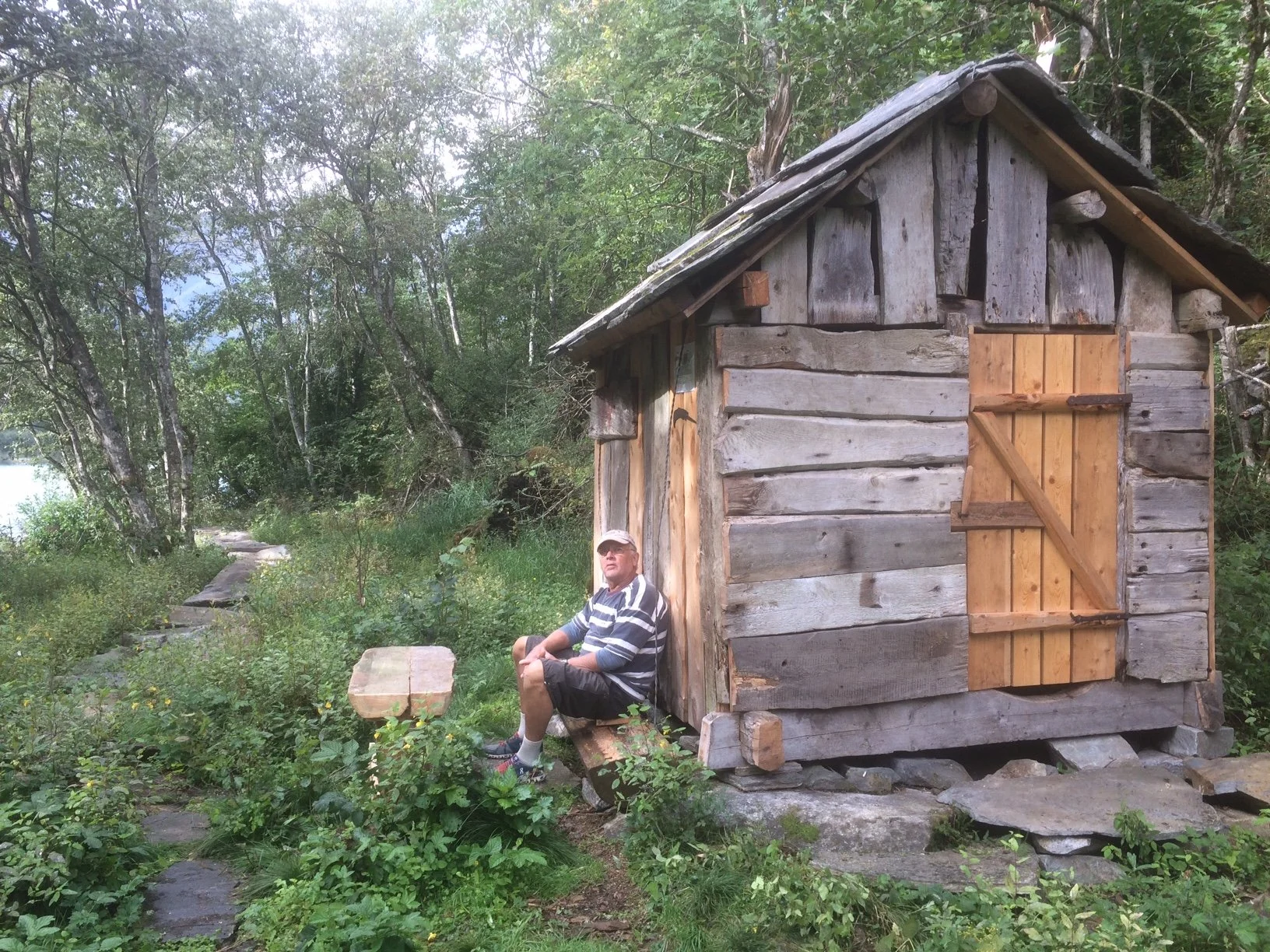
The finished work at the path to the Wittgenstein House. My good friend Terje Lium from Bærum is resting well after participating in volunteer work on 12 different projects in Luster.